Welcome to the most exciting corner of Cosmie — where space becomes fun, mysterious, and full of stories.
Dive into amazing facts, unbelievable discoveries, and cosmic stories that make the universe even more fascinating.
Mind-Blowing Space Facts
Did you know?
- A day on Venus is longer than a year
- Neutron stars are so dense that a spoonful weighs billions of tons
- There are more stars in the universe than grains of sand on Earth
Featured Story: The Night That Changed Everything
On a quiet night, far away from the noise of the city, a young sky-lover lay on the rooftop, staring endlessly at the stars. The sky was clear, painted with thousands of tiny lights, each holding a mystery.
As the hours passed, something unusual happened — a bright streak crossed the sky. A meteor, fast and brilliant, vanished within seconds. But in that fleeting moment, it sparked something powerful: curiosity.
Questions began to flow —
What are stars made of?
How far does the universe go?
Are we alone?
That single moment turned into a journey.
Days turned into nights of learning. Constellations were no longer just random patterns but stories written across the sky. Planets became neighbors. The Moon became more than just a glowing circle — it became a world.
This is how explorers are born — not in laboratories, but under open skies.
At Cosmie, we believe every great journey begins with a single look up
Fun Facts
- The largest constellation is Hydra
- The smallest is Crux
- Constellations are like a map of the sky
Space and Solar System Facts
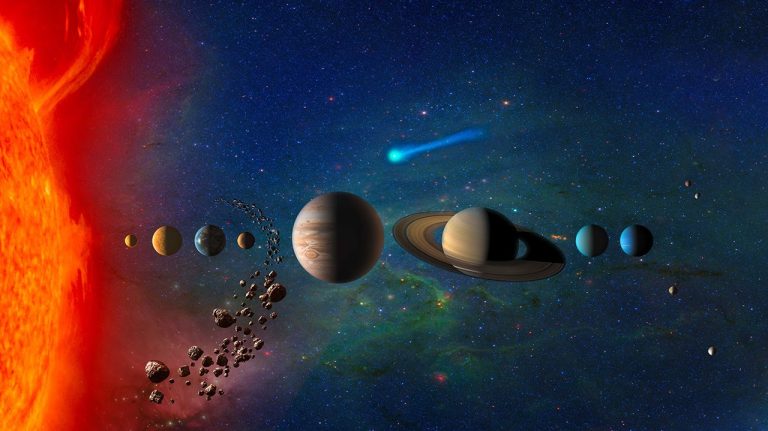
- The Sun and Planets: One million Earths could fit inside the Sun. The solar system consists of eight planets, which all orbit the Sun, a medium-sized star.
- A “Day” Longer Than a “Year”: Venus takes longer to rotate once (243 Earth days) than to orbit the Sun (225 Earth days).
- No Sound in Space: Because space is a vacuum with few molecules, sound waves cannot travel.
- Extreme Temperatures: The void of space is around .
- Stellar Distances: When you look at stars, you see them as they looked in the past, ranging from 8.5 minutes ago for the Sun to millions of years ago for distant stars.
- Galaxy Collision: The Milky Way is expected to eventually collide with the Andromeda galaxy.
- Rogue Planets: There are “rogue planets” floating through space alone, not orbiting any star.
Constellations and Stars Facts
- Official Count: Astronomers recognize 88 official constellations.
- No True Neighbors: Stars within a constellation are usually not near each other in space; they only look close together from Earth’s perspective.
- Constellations Change: Because Earth orbits the Milky Way, constellations appear in different locations throughout the year, and they looked completely different to dinosaurs 66+ million years ago.
- North Star Changes: Due to Earth’s axial precession, Polaris is not always the North Star; Vega will become the North Star in approximately 13,000 years.
- Naming Constellations: Meteor showers are often named after the constellation from which they appear to originate, such as the Orionids from Orion.
- Brightest and Closest: The brightest stars in the night sky are not necessarily the closest to us.
- Star Lifespan: The more massive a star, the shorter its lifespan.
Interesting Cosmic Phenomena
- Milky Way’s Scent: Due to chemical compounds (ethyl formate) found in the galaxy’s center, scientists believe the Milky Way might smell like rum and raspberries.
- Water on Other Worlds: Some moons in our solar system, such as Jupiter’s Europa, have more water than Earth.
- Black Holes: Gravity near a black hole is so intense it warps time.
- Supernova Remnants: A star explosion that occurred up to 20,000 years ago left a 130-light-year-wide ring of debris known as the Veil Nebula.
Space Stories
The First Moon Landing
In 1969, humans landed on the Moon for the first time during the historic Apollo 11 Moon Landing. Astronauts Neil Armstrong and Buzz Aldrin walked on the lunar surface.
Neil Armstrong said: “That’s one small step for man, one giant leap for mankind.”
The Story of Orion
The constellation Orion comes from ancient mythology. Orion was a great hunter placed among the stars. Today, you can still spot Orion’s Belt shining brightly in the night sky.
The Mystery of Comets
Comets are icy travelers from the outer solar system. When they come close to the Sun, they create glowing tails, making them one of the most beautiful sights in space.
Journey to Mars
Humans are preparing to explore Mars in the future. Space agencies like NASA are planning missions to send astronauts to the Red Planet.
Did You Know?
- The Moon is slowly moving away from Earth every year
- One million Earths can fit inside the Sun
- Black holes can bend space and time.
Quote of the Universe
“Across the sea of space, the stars are other suns.”